
What Is Demand Forecasting?
Demand forecasting is the process of predicting how much of each product your customers will buy over a given period. For Shopify brands, this typically means projecting sales for each SKU over the next 3 to 12 months.
Good forecasting is the foundation of everything in inventory management. It determines when you reorder, how much you order, how much cash you tie up in stock, and whether your customers find what they want when they visit your store.
Why Most Shopify Brands Get It Wrong
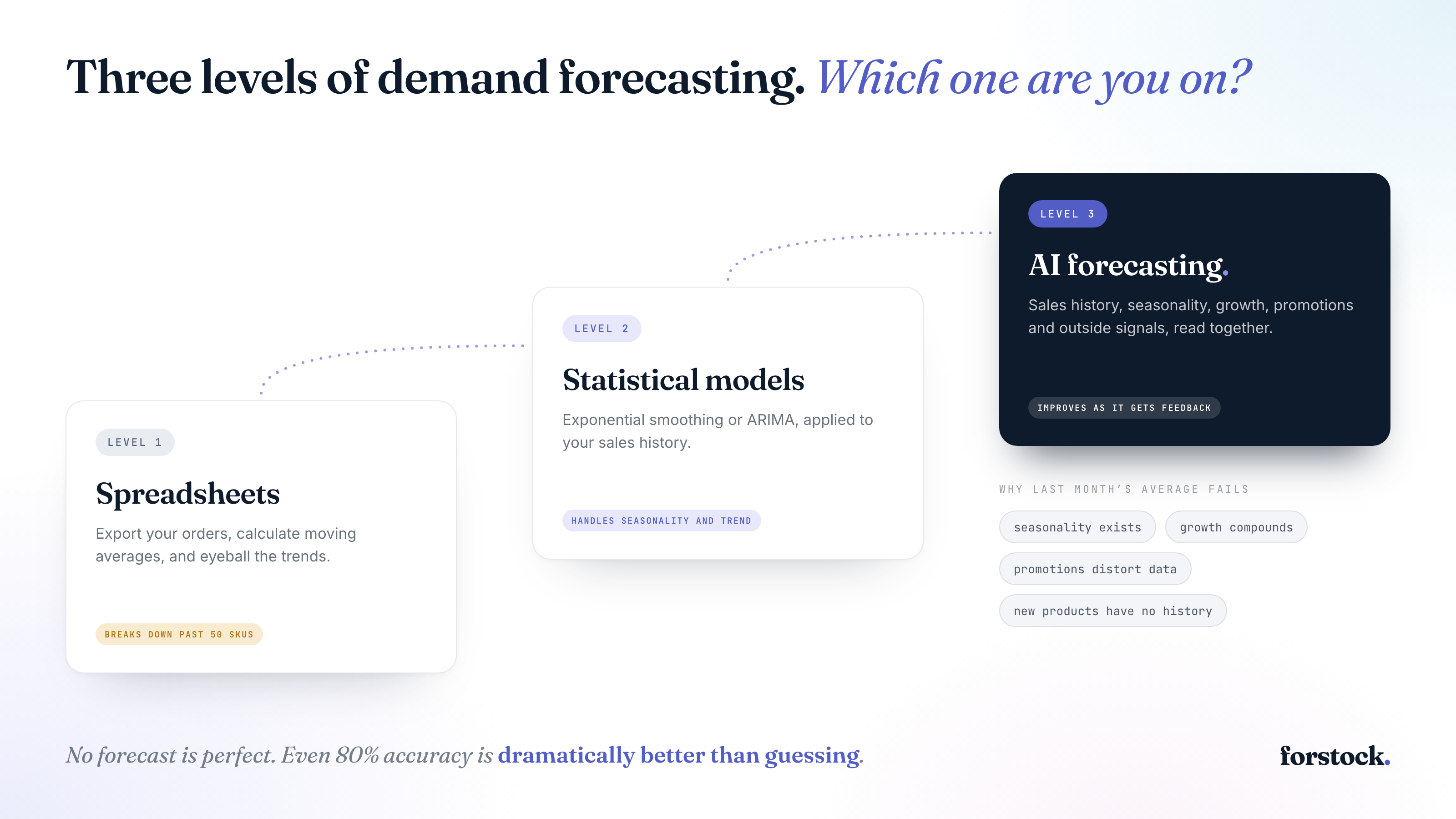
Many brands rely on gut feeling or simple averages to predict demand. A common approach is looking at last month's sales and assuming next month will be similar. This fails because:
- Seasonality exists. A swimwear brand's February sales are a terrible predictor for June.
- Growth compounds. If you're growing 10% month-over-month, last month's numbers are already outdated.
- Promotions distort data. That spike from your BFCM sale isn't your baseline demand.
- New products have no history. You can't average what doesn't exist yet.
The Three Levels of Demand Forecasting
Level 1: Manual (Spreadsheets)
You export your Shopify order data, calculate moving averages, and eyeball trends. This works for stores with fewer than 50 SKUs, but it breaks down fast. It's time-consuming, error-prone, and impossible to maintain as you scale.
Level 2: Statistical Models
Tools that apply time series models (like exponential smoothing or ARIMA) to your historical data. These handle seasonality and trends much better than averages, but they require clean data and can't easily account for external factors.
Level 3: AI/ML Forecasting
Modern AI models combine multiple signals — sales history, seasonality, growth trends, promotional calendars, and even external data — to generate forecasts that continuously improve. This is what tools like Forstock provide out of the box.
Key Concepts You Should Know
Seasonality — Recurring patterns tied to time of year. Think holiday spikes, summer slowdowns, or back-to-school rushes.
Trend — The long-term direction of your sales. Are you growing, plateauing, or declining?
Lead Time — How long it takes from placing a PO to receiving inventory. This determines how far ahead you need to forecast accurately.
Forecast Accuracy — No forecast is perfect. The goal is to be close enough to make good decisions. Even 80% accuracy is dramatically better than guessing.
How to Start Forecasting Today
- Export 12+ months of order data from Shopify
- Identify your top 20% of SKUs — these drive 80% of your revenue
- Look for patterns — monthly trends, seasonal peaks, growth rates
- Set reorder points based on your forecasts and lead times
- Review and adjust monthly — forecasts improve with feedback
Or skip the manual work entirely and let AI do it. Tools like Forstock connect to your Shopify store, import your data, and generate 12-month forecasts automatically — no spreadsheets required.